IPK Leibniz-Institut/ S. Balyberdin
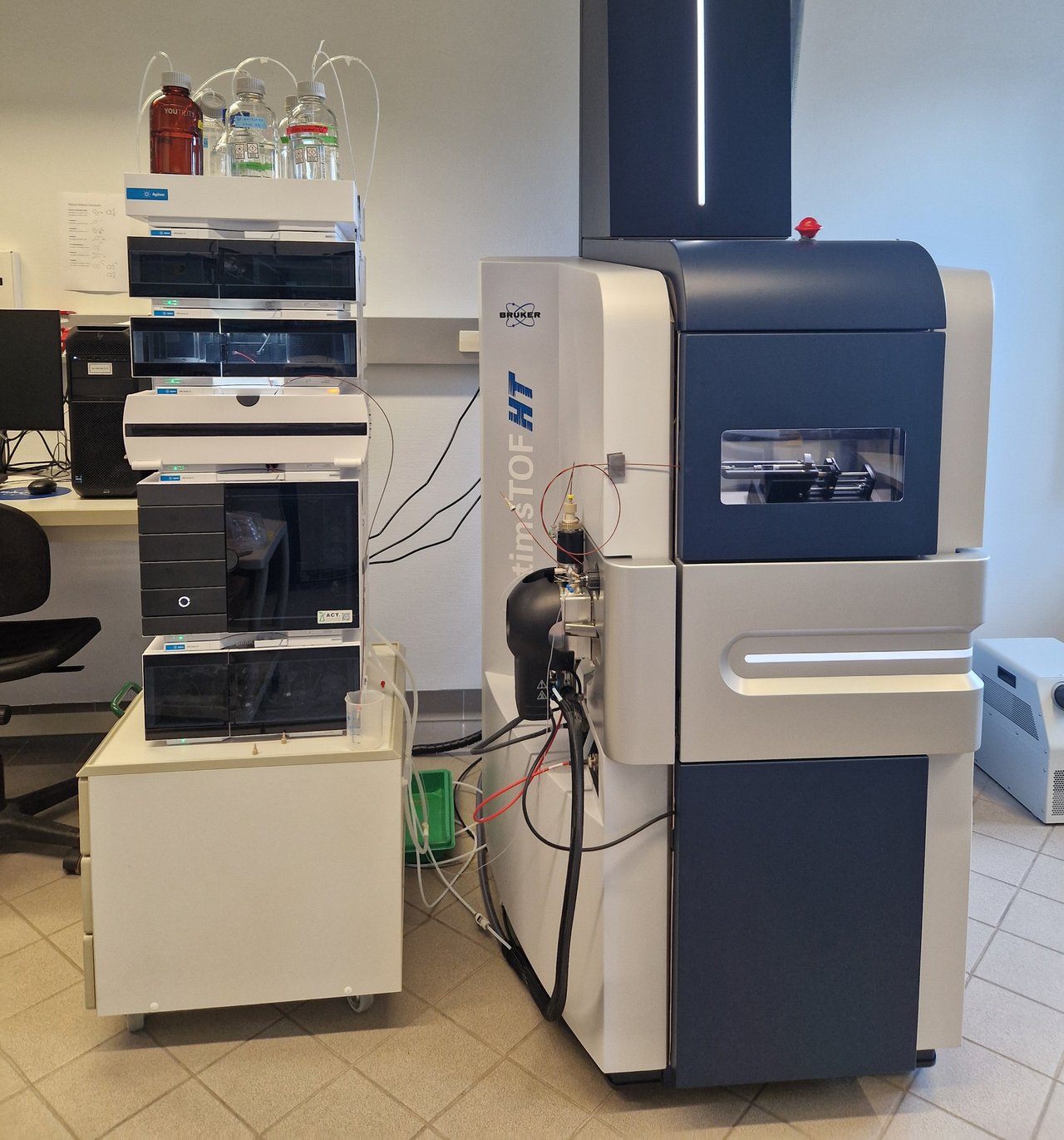
With the Bruker timsTOF HT, our institute operates a state-of-the-art mass spectrometry platform delivering exceptional sensitivity, speed, and resolution for advanced metabolomics applications. By integrating Trapped Ion Mobility Spectrometry (TIMS) with high-resolution Q-TOF mass spectrometry, the system enables highly precise separation, identification, and quantification of complex metabolite profiles, even in challenging sample matrices. Its outstanding acquisition speed, ion mobility resolution, and reproducibility make it particularly well suited for large-scale, high-throughput metabolomics studies with the highest analytical quality standards.
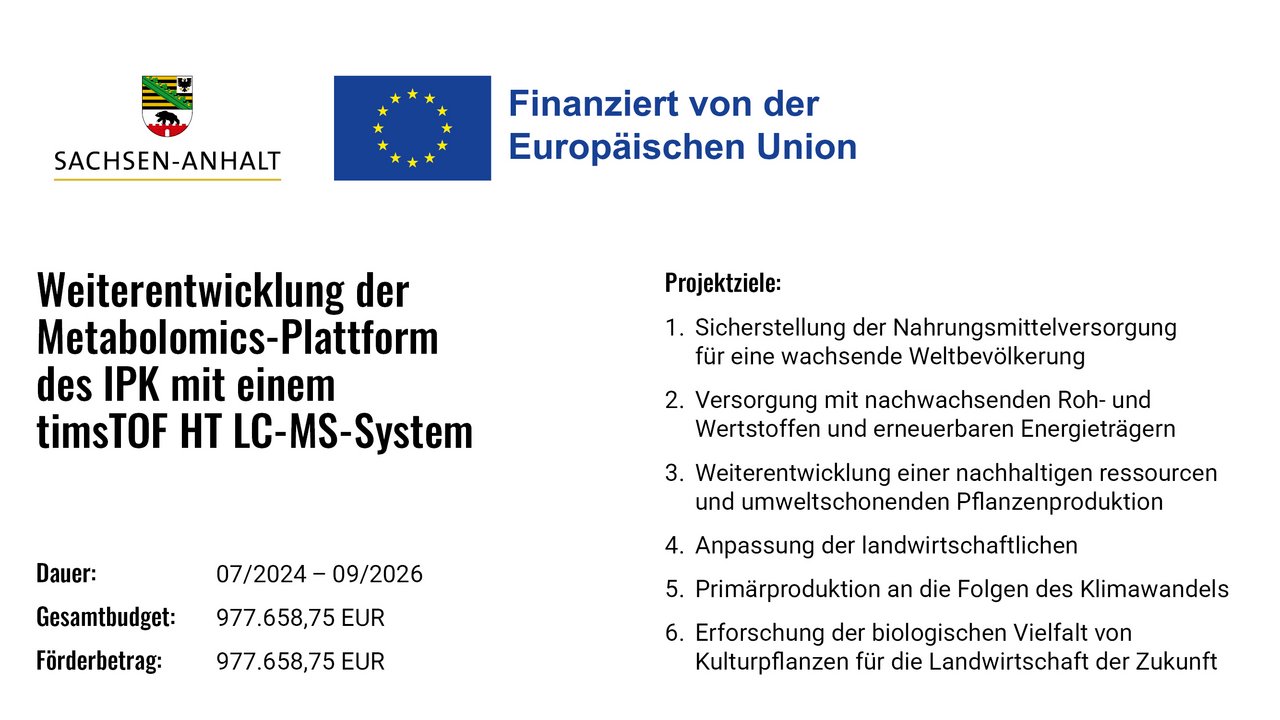
The EU-funded acquisition of this instrument directly supports key project objectives: ensuring food security for a growing global population, advancing sustainable and resource-efficient crop production systems, enabling the development of renewable bio-based raw materials and energy sources, adapting agricultural primary production to climate change, and exploring the biological diversity of crop plants for the agriculture of the future. Through its advanced analytical capabilities, the timsTOF HT provides deep insights into plant metabolic networks and stress responses, thereby contributing to the development of resilient, high-performance crops for sustainable agriculture.
Further, the following instruments and system are used in analytics at IPK:
- The ionomics platform consists of an ICP-MS (Inductively Coupled Plasma - Mass Spectrometry) and ICP-OES (Inductively Coupled Plasma- Optical Emission Spectrometry) for high-throughput, simultaneous and high-resolution determination of mineral elements in plant tissue samples, media or liquids. Prior to analysis, plant tissues are wet digested in nitric acid in a microwave under high pressure.
- Element analysis is flanked by an IR-MS (isotope ratio mass spectrometer) that differentiates between 14N and 15N as well as 12C and 13C when determining N and C contents in plant samples. This isotope discrimination technique allows using non-radioactive tracers to investigate transport pathways and metabolic conversions of nutrients and metabolites.
- LC-MS (Liquid-Chromatography-Mass-Spectrometry) is applied to obtain profiles of phenylpropanoids and other semipolar compounds. Unknown metabolites associated with plant stress defense responses or compounds with potential health effects for human nutrition are purified with preparative chromatography for structural elucidation or for application in nutritional studies.
- The GC-TOF (Gas-Chromatography coupled to Time-of-Flight Mass-Spectrometry) platform performs routine non-targeted analysesof polar and semi-polar analytes, it is equipped with an autosampler system designed for autonomous high-throughput sample preparation.
- Our LC-QTOF (Liquid-Chromatography Quadrupole Time-of-Flight) system is designed for accurate mass measurements of plant-based metabolites ranging from lipids and other polar compounds through sugars and amino acids. The platform's normal ESI source (Electrospray Ionisation) can be rapidly changed over to a chip-based nano-electrospray infusion source for the study of low volume samples, or to repeatedly collect small volume fractions of precious samples for later downstream experimentation.
- The protein characterization platform consists of robust homogenization followed by chromatographic separation using a high-pressure capable purification system coupled with UV detection. Fractions can be collected for further separations or biochemical analysis.
Multiple additional liquid chromatography platforms exist within the institute and are commonly equipped with both diode array and fluorescence detectors.