History
Overview
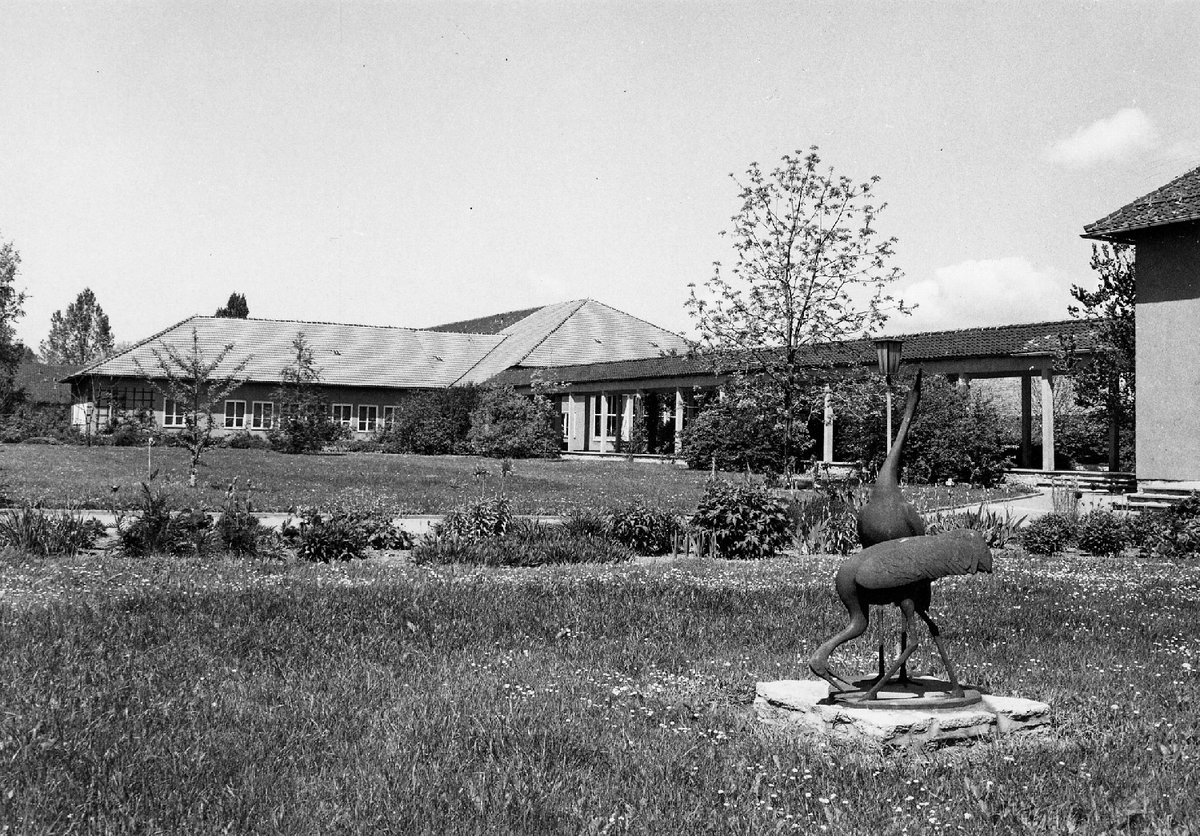
The Kaiser Wilhelm Institute for Crop Plant Research was founded at Tuttenhof near Vienna in 1943, incorporated into the GDR Academy of Sciences in 1948 and re-established as IPK in 1992. Over the course of the Institute’s 75 years existence, it has developed into a world-leading plant research centre. Its current population of 180 scientists and 60 PhD students come from more than 42 countries.
Chronology
| 1943 | Founded as the Kaiser Wilhelm Institute for Crop Plant Research in Tuttendorf (near Vienna), with Hans Stubbe as its first director. |
| 1945 | Relocated to Stecklenberg/Harz due to war exigency, and settled in Gatersleben in October of that year. |
1946
1948 | Affiliated with the University of Halle-Wittenberg, while retaining the name Kaiser Wilhelm Institute for Crop Plant Research. Incorporated into the German Academy of Sciences in Berlin (DAW) as the DAW Institute for Crop Plant Research. |
| 1948-1964 | Construction of the Gatersleben campus buildings. |
| 1970 | Renamed as the DAW Central Institute for Genetics and Crop Plant Research (ZIGuK); in 1972 its affiliation was changed from DAW to the GDR Academy of Sciences (AdW). |
| 1992 | Re-constituted as the Institute of Plant Genetics and Crop Plant Research (IPK). |
| 2003 | Merger with the Braunschweig Gene Bank to form the Federal Ex situ Gene Bank for Agricultural and Horticultural Crops, based at IPK. |
| 2006 | Renamed as the Leibniz Institute of Plant Genetics and Crop Plant Research. |
| 2019 | The Leibniz Association Senate certified the Institute's excellence, in recognition of it status as one of the world's leading plant research institutes. |
| 2021 | IPK PhenoSphere (Plant Cultivation Hall) for creating controlled but field-like conditions becomes fully functional |
Directors of the Institute
| 1943 - 1969 | Prof. Dr. Drs. h. c. Hans Stubbe |
| 1969 - 1983 | Prof. Dr. Helmut Böhme |
| 1983 - 1989 | Prof. Dr. Dieter Mettin |
| 1990 - 1991 | Prof. Dr. Klaus Müntz |
| 1992 - 2007 | Prof. Dr. Ulrich Wobus |
| 2007 - 2023 | Prof. Dr. Andreas Graner |
| since 2023 | Prof. Dr. Nicolaus von Wirén |
Famous people
Important foundations for plant research, which also underpin our work at the IPK Leibniz Institute, are linked to many eminent researchers. Agricultural scientists, physiologists, chemists, and breeding researchers such as Nikolai Ivanovich Vavilov and Justus von Liebig all helped lay the groundwork for our research. Some of them have direct links to the Institute. At IPK, these pioneering figures are honoured through buildings bearing their names and busts on the campus. In addition, streets in the village bear their names.
As part of a citizen science project, two former IPK staff members, Gudrun Mönke and Jürgen Hofemeister, researched and compiled details of the lives and work of these individuals. The resulting texts are intended to introduce interested readers, particularly those working at the Institute today, to the lives and achievements of these individuals and encourage reflection on their work in relation to their own.
Several things stand out. Currently, only men are commemorated in this way at the Institute. Buildings such as the Genome Centre, which are not named after a specific person, already exist at IPK and could help to address this imbalance. With the benefit of hindsight, it can sometimes be difficult to recognise something that seems self-evident today as a groundbreaking concept, an innovative method, or a fundamental breakthrough in knowledge. Contextualising the time and ‘zeitgeist’ in which these individuals lived can tempt us to look down on the past from the vantage point of hindsight. Therefore, it may be worthwhile to view our actions, decisions, and omissions through the eyes of future generations and draw conclusions from that perspective.
The texts are intended to inform, stimulate and encourage reflection. We, the IPK Managing Office team, would also welcome any comments, suggestions, or additions.
| 1875–1933 | Erwin Baur |
| 1864–1933 | Carl Erich Correns |
| 1803–1878 | Justus von Liebig |
| 1845–1920 | Wilhelm Friedrich Philipp Pfeffer |
| 1902–1989 | Hans Stubbe |
| 1887–1943 | Nikolai Ivanowitsch Vavilov |
| 1844–1895 | Friedrich Miescher |
| 1910–1995 | Konrad Zuse |
| 1883–1951 | Theodor Roemer |
Showpieces and collectibles
“Comeback” for Old Barley Varieties
This Assyrian relief symbolises the tradition of crop research
Colossus paves the way for IPK.