Erwin Baur
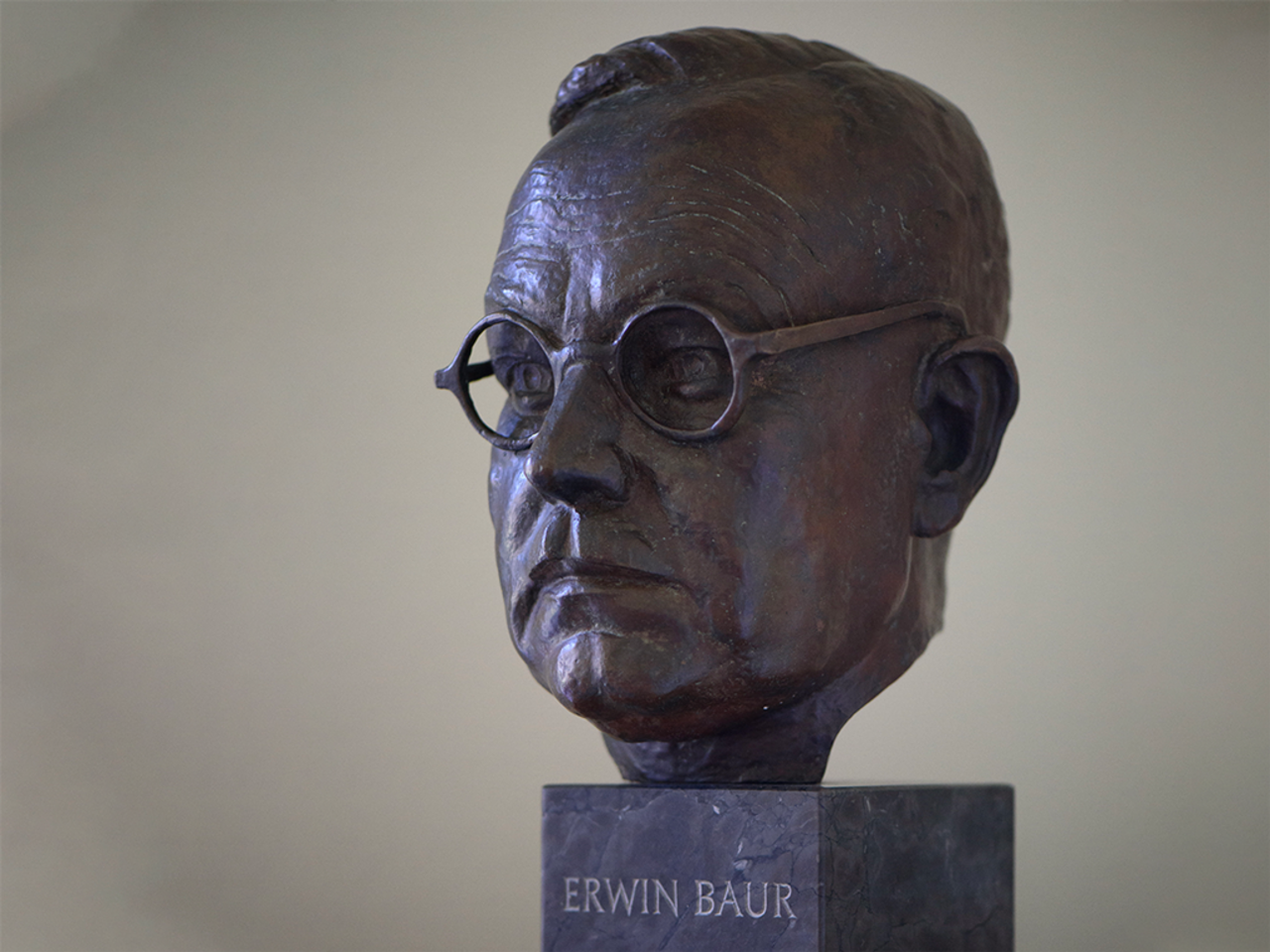
Erwin Baur (1875–1933)
Erwin Baur (1875–1933)
The geneticist and plant breeding researcher Erwin Baur is regarded as one of the pioneers of modern plant research in Germany. In 1928, he became the founding director of the ‘Kaiser Wilhelm Institute for Breeding Research’ in Müncheberg, and he was a teacher to Hans Stubbe, the founding director of what is now the IPK Leibniz Institute in Gatersleben. However, his contribution to a seminal work on racial hygiene also drew criticism and necessitates a nuanced view of research and science within their historical context.
Erwin Baur was born in Ichenheim, Baden, in 1875. He studied medicine, qualified as a doctor in Kiel at the age of 25, completed his military service in the Navy in 1901–02, and then worked as a doctor in psychiatric institutions in Kiel and Emmendingen. In 1903, he became an assistant at the Botanical Institute of the University of Berlin. His work paved the way for new fields of study in botany; from 1907 onwards, he delivered his first lectures on genetics and wrote two textbooks, including the first German-language textbook on genetics. Together with Carl Correns, he carried out extensive cross-breeding experiments in 1909 on pelargoniums, a member of the geranium family. The traits studied did not follow ‘Mendel’s laws’. In this way, Baur discovered the inheritance of plastids.
His interest in experimental genetics and plant breeding through cross-breeding and mutation led him to take up the Chair of Botany at the Agricultural University in Berlin in 1911. It was here that, in 1914, Baur was appointed to the first chair of genetics at a German university. Together with Carl Correns and Richard Goldschmidt, he founded the German Society for the Study of Inheritance in 1921 and, in 1922, became a member of the Emergency Association of German Science, the predecessor organisation of today’s German Research Foundation (DFG).
As a geneticist and plant breeder, Erwin Baur is committed to improving agricultural productivity through breeding innovations. However, he also takes a keen interest in the ideas of eugenics that were emerging at the start of the 20th century. Eugenics, as a field of research, deals with hereditary diseases and their transmission. ‘Positive’ eugenics aims to select the so-called ‘fit’. ‘Negative’ eugenics is intended to prevent the birth of so-called ‘inferior’ individuals. The National Socialists pursued the latter aim. Several hundred thousand people were forcibly sterilised or killed by the end of their dictatorship. Eugenics was not, however, a purely European phenomenon. From 1900 onwards, eugenics found enthusiastic supporters in England, Germany and other European countries, but particularly in the USA. Many of them were doctors.
At the same time, the concept of ‘racial hygiene’ developed, according to which the Nordic race was regarded as superior. The two ideas overlapped in both content and in the people involved.
Amidst these discussions, the textbook ‘An Outline of Human Heredity and Racial Hygiene’ by Erwin Baur, Eugen Fischer and Fritz Lenz was published in Germany in 1921. It also became the international standard work on racial hygiene. In the introductory chapter, Baur describes the fundamentals of genetics. Fischer and Lenz wrote the main body of the book, which covered eugenics, race, and racial hygiene. Nevertheless, Baur was criticised for his involvement in this work because, despite his assertion that there were no ‘pure’ human races and no ‘pure Aryan race’, he did not consistently speak out against racial hygiene ‘purification and selection theories’ in this context.
Erwin Baur was internationally recognised as a geneticist and plant breeding researcher. As organiser and president, he succeeded in bringing the ‘5th International Congress of Genetics’ to Berlin in 1927. To expand research opportunities, he and Ferdinand von Lochow submitted a proposal for an ‘Institute for Plant Breeding Research’, which the Kaiser Wilhelm Society approved in 1927. On 29 September 1928, he opened ‘his institute’, the ‘Kaiser Wilhelm Institute for Plant Breeding Research’, in Müncheberg near Berlin, taking up the post of director. In doing so, Baur laid the foundations for modern plant breeding and mutation research in Germany. Baur’s student Hans Stubbe, the founding director of what is now the IPK Leibniz Institute, wrote in 1959: ‘No one today can fully appreciate the immense effort that went into this work, which was already in full bloom in the few years leading up to his death.’
From 1933 onwards, problems arose regarding the institute’s funding. This led to disputes with Richard Walther Darré, Reich Minister of Food and Agriculture (German: Reichsminister für Ernährung und Landwirtschaft). He was unwilling to meet Baur’s financial demands, but sought to exert influence over the research. The conflicts reached a climax on 29 November 1933, when a board of trustees commissioned by the Ministry arrived in Müncheberg to assess the institute. Baur was devastated and deeply hurt. On 2 December 1933, he died as a result of a heart attack.
Erwin Baur did not live to see the criminal and mass ‘extermination of worthless and undesirable life’ carried out by the National Socialists after they seized power in 1933. In his 1934 obituary, Hans Stubbe wrote of his mentor: ‘Baur’s work was driven by the noble ideal of helping his people, and he led the fight against the hardships facing agriculture with the boldness and determination of a great military commander.’ Experts (including Hans-Peter Kröner, 1994) attest that Erwin Baur cannot be held intellectually responsible for the historical crimes committed by National Socialism. Nevertheless, his work on human genetics was used under National Socialism to legitimise concepts that led to racial policies and racial legislation.
For many of us living today, viewing Erwin Baur’s work solely in the context of his era does not do it justice. This highlights the responsibility that rests upon science, research and the pursuit of knowledge - and how these can be utilised, but also misused, reinterpreted or co-opted. It is a responsibility from which we neither wish nor can shirk.
Erwin Baur received a posthumous honour in 1938 when his institute was given the suffix ‘Erwin-Baur-Institute’. In February 1945, most of the institute was relocated to Cologne. Following the end of the Second World War, the fall of the Nazi dictatorship and the division of Germany, it developed into what is now known worldwide as the ‘Max Planck Institute for Plant Breeding Research’. The part that remained in Müncheberg reopened on 1 October 1945 as the ‘Central Research Institute for Plant Breeding (Erwin-Baur Institute)’ and was later renamed the Leibniz Centre for Agricultural Landscape Research (ZALF) e. V. in 1997.