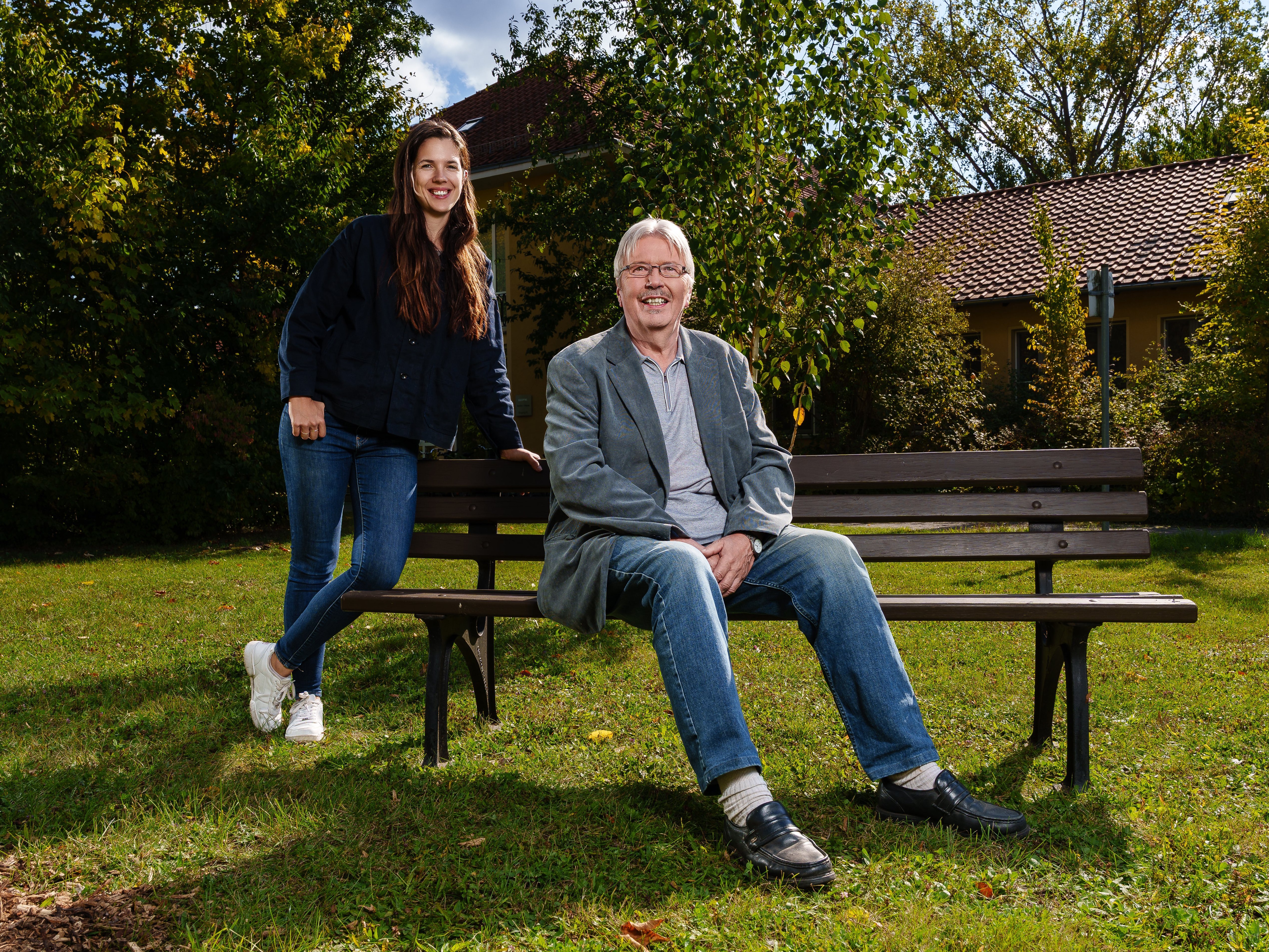
Anna Backhaus has taken over the ‘Resource Genetics and Reproduction’ research group from Andreas Börner. This is reason enough to meet both of them for a double interview in the ‘Vavilov Building’.
IPK Leibniz-Institut/ S. Balyberdin
Passing the baton at the Genebank
Mr. Börner, you have been at the institute since 1985. How did you come to Gatersleben? What was your first day at work like?
Andreas Börner: I studied plant breeding at the University of Halle and was already familiar with the Institute of Genetics and Crop Plant Research, having visited it on excursions before applying. Even back then, cutting-edge research was being conducted here, which inspired me as a young researcher. However, the situation for young scientists was less competitive back then than it is today.
On my first day, I reported to the ‘Management department’ and was shown to my office. It was a room for four doctoral students. Everyone had a desk and a chair - nothing more. I was the only person with a calculator, though, which I had bought at Intershop beforehand.
And what was it like for you, Ms. Backhaus?
Anna Backhaus: Actually, it was pretty much the same. I initially worked in human resources, and then I came to my office, which had a desk and a chair. Unlike Andreas Börner, I didn’t have a calculator with me, but a laptop was waiting for me, and a colleague had put a flower on my desk, which was a nice touch. Then I met Andreas Börner and Nils Stein, after which I started work.
What did you do before? What attracted you to the position at the IPK?
Anna Backhaus: I worked at the John Innes Centre for a total of eight years, where I was involved in the molecular genetics of wheat. After that, I spent almost three years at ICARDA (the International Centre for Agricultural Research in Dry Areas) in Morocco. There, I mainly worked on the pre-breeding of cereals. Although I am from Bonn, this is actually my first job in Germany.
And when did the two of you actually meet for the first time?
Anna Backhaus: On St. Nicholas’ Day in 2024. I’ll never forget it, because it was the day I gave my first presentation in the IPK lecture hall.
The Genebank is undoubtedly the heart of the IPK, as reflected in the new research strategy. When were you given responsibility for parts of the gene bank?
Andreas Börner: I initially had a junior research group. Then, in 1996, the Scientific Advisory Board decided to transfer responsibility for reproduction, cultivation, and long-term conservation to me, effective from 1 January 1997.
Many are aware of the cold storage chambers used to preserve jars and of the routine transfer of duplicate samples to the Global Seed Vault in Svalbard. Could you elaborate on the other responsibilities included in your remit?
Andreas Börner: Reproduction cultivation is definitely the core task. But it’s also about creating and maintaining evaluation data, providing material for the herbarium, and distributing seeds. Every year, we send around 20,000 seed samples to interested individuals, institutions, and breeders.
How has your work changed over the years?
Andreas Börner: The processes have basically remained the same, but I would like to highlight two points. In the past, we mostly worked with index cards, and most of the data was only used internally. Digitalisation has naturally changed things, and today, interested parties from all over the world have access to our data.
Looking back, how do you feel about preserving and maintaining this ‘treasure’?
Andreas Börner: I am, of course, also proud that we have maintained the high quality of the Genebank’s accessions over such a long period of time. And you are right - it is a treasure. I wanted to preserve it for us, our children, and our grandchildren. I often explained this during guided tours of the gene bank.
As a young scientist, what does it feel like to be entrusted with such a ‘treasure’, containing 130,000 samples at the Gatersleben site alone?
Anna Backhaus: I consider it a great privilege. At first, I felt a mixture of anticipation and excitement. However, that quickly subsided when I realised that an incredibly well-coordinated team supports the gene bank.
Did you feel enthusiastic about the job immediately when you saw the advertisement, or did you need time to think it over and seek advice?
Anna Backhaus: To be honest, I had always dreamed of this exact position. However, when I saw the job advertisement, I hesitated for a moment and required a little encouragement from my doctoral supervisor. Then I was happy to leap into this position of responsibility.
How did you organise the handover?
Andreas Börner: I have explained a lot to Anna Backhaus and involved her in the daily work right away. For example, she has been attending the weekly meetings with the heads of the product range groups and Peter Schreiber from the outset. We also recently created many documents together, including the research and development programme and the equipment plan.
The ongoing development of the gene bank into the world's leading ‘Biodigital Resource Centre’ is, of course, still in progress. But what exactly does this redefinition entail?
Anna Backhaus: Terminology is always open to debate, of course, but the idea behind it is definitely the right one. The aim is to provide the highest quality data worldwide and enable users to find the exact data they need for their specific enquiries. This includes phenotypic and genetic data, as well as passport information on the origin and taxonomic identification of the accessions.
What questions would you like to tackle next?
Anna Backhaus: I focus on wild cereal relatives and aim to improve crossbreeding with cultivated varieties to better utilise their valuable genetic diversity.
The Genebank was the focus of media attention and remains the highlight of every institute tour to this day. You have always enjoyed doing both. Why is that?
Andreas Börner: Yes, I have always felt the need to explain to others what we do here. This applies to journalists as well as to groups visiting on open days. Some people had already heard about the Global Seed Vault in Svalbard, but they are always surprised to discover that there is a gene bank just like it on their doorstep.
However, your interests extend beyond pure science. For example, you are very interested in the new discourse project currently being launched by the IPK and the Burg Giebichenstein University of Art and Design in Halle. Where does this interest come from?
Anna Backhaus: I have always been fascinated by dialogue with other disciplines, such as philosophers, climate researchers and industrial designers. This is precisely what the discourse project with Burg Giebichenstein is all about. The biodiversity we preserve here provides an excellent interface for this.
Mr. Börner, to be honest: how difficult is it for you to say goodbye to 'your' Genebank?
Andreas Börner: Of course, after 40 years at the institute and 30 years of responsibility for the gene bank, it’s a significant change. But I am convinced that Anna Backhaus will maintain the high standard of conservation and also provide new impetus. It’s essential to reassess after a long period, and I’m confident she will manage the Genebank well.